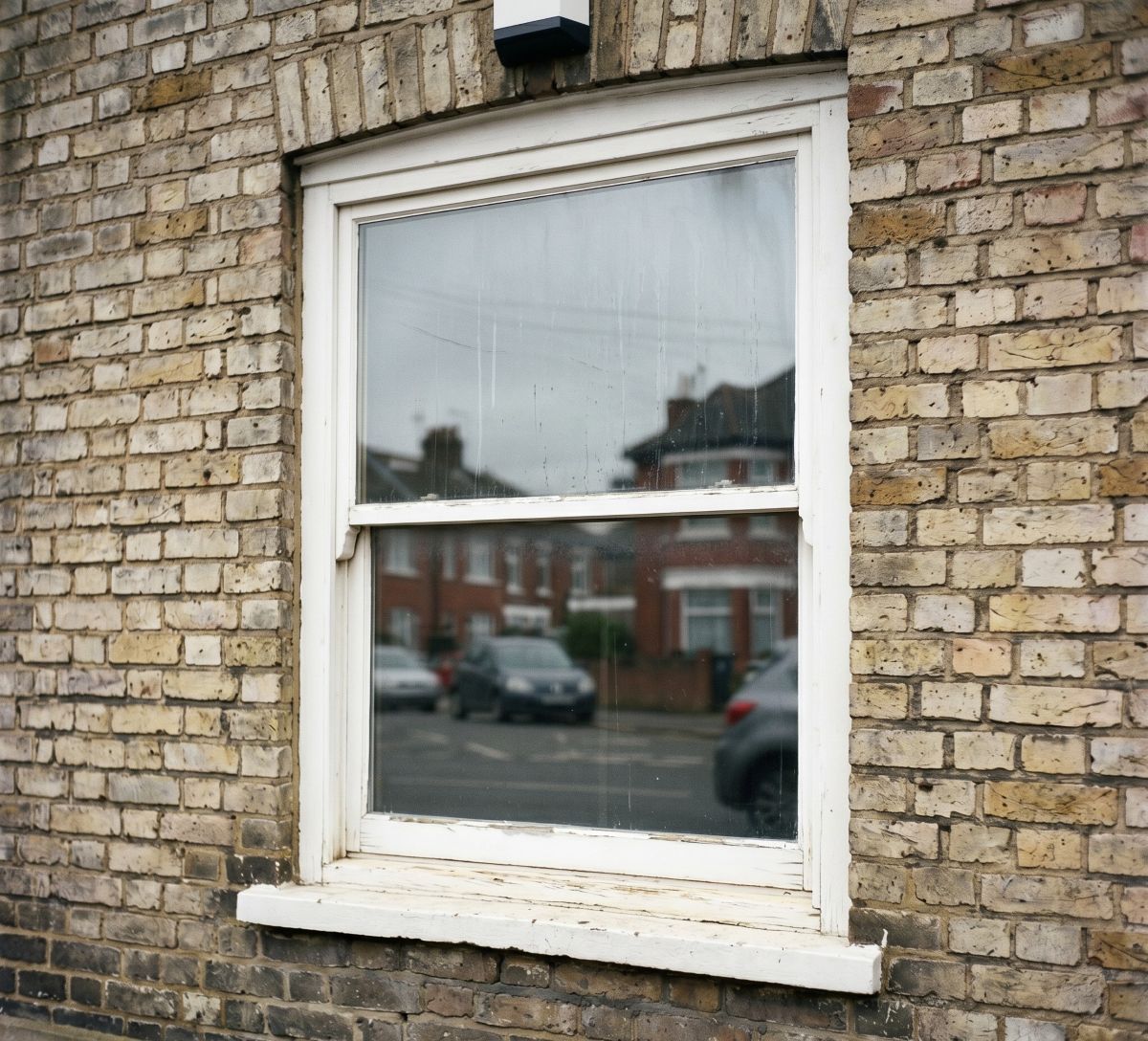
There is a stretch of Watford Way, somewhere between the Hendon Central roundabout and the Welsh Harp junction, where I have cleaned the same windows more times than I can count. The businesses there are well-run, tidy, conscientious. Their owners book regular cleans and their premises reflect that. And yet, almost without fail, there comes a point in the year – usually around late autumn – when I arrive to find a cloudy, whitish haze sitting on the glass that no amount of standard cleaning will shift. It is not dirt. It is not ordinary grime from the road. It is hard water staining, and once it takes hold, it behaves by entirely different rules.
I have had business owners genuinely convinced their windows were past replacing. They were not. But the confusion is understandable. Hard water staining looks permanent, behaves stubbornly, and does not respond to the usual routine. If you run a business on or near Watford Way, or live in one of the residential streets feeding off it, there is a good chance this problem is familiar to you. Here is what is actually going on.
Why Hard Water Is Particularly Harsh in This Part of London
London sits in one of the hardest water zones in England. Thames Water’s supply to this part of North London carries a mineral content that regularly tests at well above 300 milligrams per litre – classified as very hard by any standard measure. What that means in practical terms is that the water coming out of pipes, falling as rain onto already-contaminated surfaces, or sitting in puddles that splash up against a shopfront, carries a significant load of dissolved calcium and magnesium. When that water dries, the minerals stay behind.
It is the drying that causes the problem. Water evaporates cleanly. The minerals do not go with it. They bond with the surface they were sitting on, and on glass they form a thin crystalline layer. At first, this layer is barely noticeable – a slight dullness, perhaps, a loss of the sharp reflectivity that clean glass has. Over time, without removal, the deposits build. Each new layer fuses over the last. What started as a light film becomes something considerably harder to shift.
What the water is actually doing to your glass
Glass is not as inert a surface as it looks. Under magnification, it has a texture – micro-pits and imperfections that mineral deposits can settle into and grip. Calcium carbonate, the main culprit in hard water staining, is mildly alkaline. Over repeated cycles of wetting and drying, it does not simply sit on the surface – it begins a slow chemical interaction with the silica in the glass itself. This is why old, neglected hard water staining can eventually become what professionals call etching: a physical change to the glass surface that no cleaning agent alone can reverse.
The early stages are recoverable. That is the important point. The cloudy, whitish haze that appears on windows in hard water areas like this one is mineral deposit, not damage – and mineral deposit responds to the right treatment. The line between the two is crossed gradually, which is why regular maintenance matters, but it is also why catching the problem early makes a significant practical difference.
Why Watford Way Makes It Worse Than Most Roads
Hard water is a London-wide problem. But not every window in London develops staining at the same rate, and location makes a considerable difference. Watford Way – the A41 running through Hendon – is one of the busiest arterial roads in North London. It carries heavy goods vehicles, buses, delivery lorries, and a constant stream of commuter traffic throughout the day and into the evening. That volume of traffic produces an enormous amount of airborne particulate matter: tyre rubber, brake dust, diesel residue, and fine road film that drifts and settles onto every nearby surface.
On its own, road particulate is straightforward enough to clean. The problem is what happens when it combines with hard water mineral deposits on a glass surface. The two bond together. The organic material in road grime gives the mineral deposit something to grip, and the mineral layer in turn traps the grime within it. The result is a compound stain that is considerably more stubborn than either element would be separately. I have cleaned windows fifty metres back from Watford Way and windows directly facing it, and the difference in buildup rate is noticeable every time.
Traffic, dust, and the way grime bonds with mineral deposits
The mechanism is worth understanding, because it explains why simply cleaning more often does not always solve the problem on its own. Standard window cleaning – squeegee, pure water, routine polish – removes surface grime effectively. What it does not do is dissolve mineral deposits that have already bonded to the glass. So a window cleaned regularly with standard methods can still develop a deepening haze over time, because each clean removes the top layer of dirt whilst the mineral base remains and continues to accumulate.
Buses are a particular factor on Watford Way. The stop-start pattern of bus traffic generates more brake dust than free-flowing vehicles, and buses run close to the kerb – directly alongside shopfronts and the ground-floor windows of residential buildings. Properties within twenty or thirty metres of a bus stop will almost always show faster staining than those further along the road.
What Hard Water Staining Actually Looks Like Up Close
One of the reasons hard water staining catches people out is that it does not look the way most people expect damage to look. It is not a scratch. It is not discolouration in the conventional sense. It presents, in its early stages, as a soft cloudiness – a reduction in the glass’s clarity and reflectivity that is easy to attribute to something else. Light catches it differently depending on the angle. In direct sunlight it can look almost like a fine frost on the surface. On an overcast day it might simply appear as a general dullness.
As it progresses, the pattern becomes more distinctive. You start to see the outline of water droplets and rivulets – the ghost of rain running down the glass and evaporating in place. Circular patches where water pooled. Horizontal lines where splash-back has dried repeatedly in the same spot. The glass does not look dirty in the way that a smeared or dusty window looks dirty. It looks as though something has changed about the glass itself, which, in the later stages, is precisely what has happened.
Telling the difference between dirt, staining, and permanent damage
The practical test is simple. Take a clean, damp cloth and wipe a section of the affected glass firmly. If the haze clears immediately and the glass looks sharp and bright, you are dealing with surface dirt – straightforward to sort. If the haze remains after wiping, and the glass still looks cloudy or dull once dry, you have mineral staining. That is treatable. If the haze remains even when the glass is wet – if you can see the cloudiness or distortion clearly when looking through water sitting on the surface – you may be looking at etching, which is a structural change to the glass rather than a deposit on top of it.
Etching is the point of no return in most cases. A professional can sometimes improve mildly etched glass with polishing compounds and considerable effort, but the results are not always satisfying and it is not a cheap process. The practical outcome for most heavily etched windows is replacement. That is why catching hard water staining in the treatable phase – when it is mineral deposit rather than etching – matters more than most people realise.
What Actually Removes Hard Water Stains From Windows
Mineral deposits are alkaline. The way to dissolve them is with acid – mild, controlled, and applied correctly. That is the underlying principle behind every effective hard water stain treatment, whether homemade or commercial.
White vinegar diluted with water is the most accessible starting point. A solution of roughly equal parts vinegar and water, applied to the glass and left to sit for several minutes before being wiped away with a microfibre cloth, will shift light to moderate staining. For anything more established, undiluted white vinegar or a citric acid solution – citric acid powder dissolved in warm water – works considerably better. Citric acid is stronger than vinegar, less pungent to work with, and widely available in powder form from supermarkets and hardware shops across North London.
For persistent or heavy staining, specialist descaling products formulated for glass give better results than kitchen acids. Products designed to remove limescale from bathroom surfaces work on the same chemical principle and are often effective on windows, though the formulation matters – some contain abrasives that can scratch glass and should be avoided entirely.
When to use DIY methods and when to call someone in
The dividing line is broadly this: if the staining appeared within the last year or two and the glass still looks clear when wet, a careful DIY treatment with citric acid solution is a reasonable first attempt. Apply the solution, allow it to dwell for a few minutes, and remove it with a soft cloth – never an abrasive pad. Rinse thoroughly with clean water and dry immediately to avoid adding fresh deposits. Repeat if necessary, and allow a day between attempts rather than scrubbing harder on the same visit.
If the staining is older, heavier, covers large panes, or sits on windows at height, a professional treatment is the more reliable route. Window cleaners working regularly in hard water areas like this one carry specialist products and, in stubborn cases, fine-grade polishing compounds that are not practical for a one-off DIY job. The other consideration is that a professional will also assess whether the staining has crossed into etching territory – which changes the conversation entirely, and is not always straightforward to judge from the inside looking out.