
Landscape architect urges residents to cut back lawns and plant natives
Michelle Chalice of Pauke Home Habitats presented strategies for ecological landscaping, citing data on water conservation and wildlife support.
Michelle Chalice, an environmental landscape architect and owner of the Keene-based Pauke Home Habitats, urged residents to shift from traditional lawn care to ecological landscaping to support local wildlife and conserve water 2:00. Chalice, who holds a degree in resource management, presented a series of slides and handouts, including the New Hampshire Guide to Upland Invasive Species, She noted there are 40 million acres of grass in the U.S., the largest irrigated crop. 3:37.
 The meeting in a minuteVideo brief · 0:33Watch
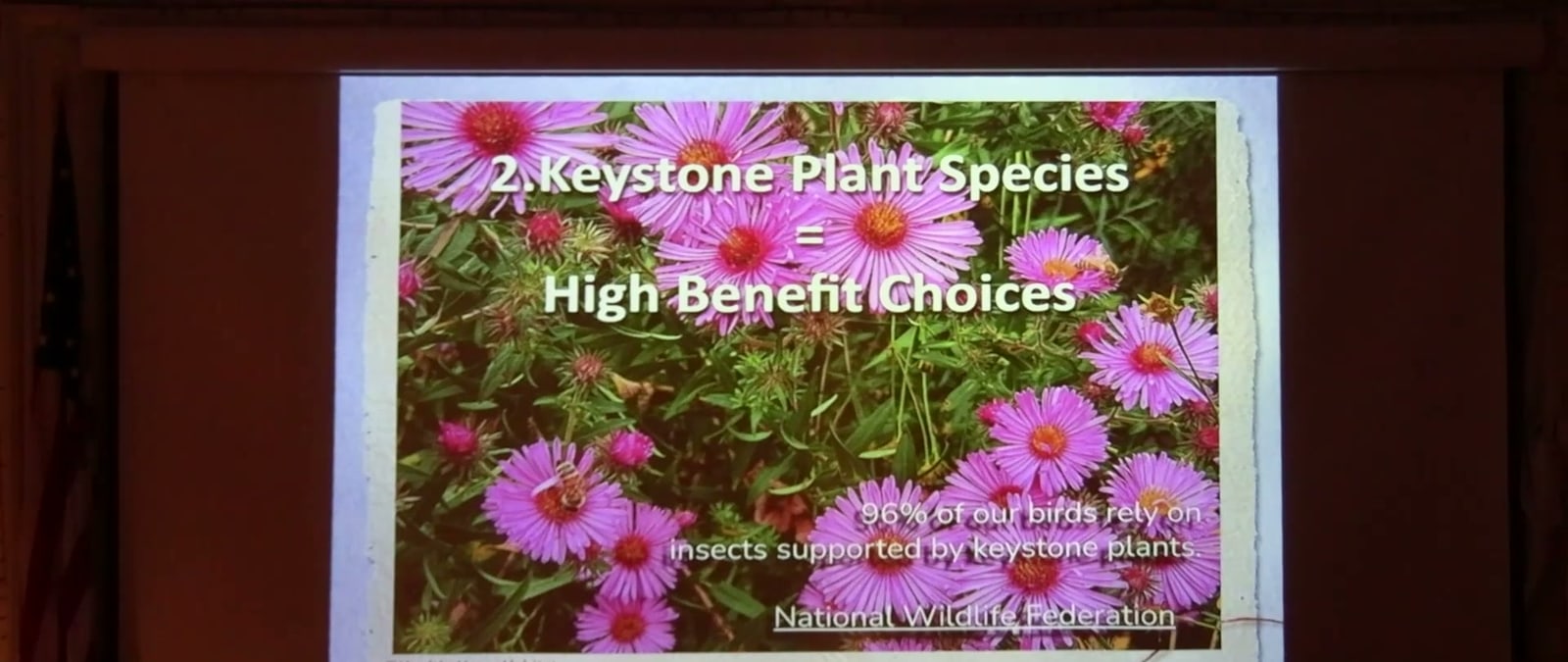
More briefs →The presentation highlighted that only 17% of native plants are considered keystone species, yet these plants support the greatest number of other species 9:21. Chalice noted that oak trees, for example, serve as larval hosts for over 700 lepidoptera species, while the Amalanger tree supports more than 100 species of butterflies and moths 13:29. She emphasized that 96% of birds rely on insects supported by these keystone plants, a statistic provided by the National Wildlife Federation 30:52.
Chalice addressed the environmental impact of conventional gardening, noting that Americans use ten times the amount of pesticides, herbicides and fertilizers Americans use ten times the amount of pesticides, herbicides and fertilizers, she said. She cited a UK study in which tiny bird skeletons in nests were filled with pesticides and herbicides 16:23. To counter this, she recommended using native plants that are adapted to local soil and weather conditions, which require less maintenance and water 24:04.
Water conservation was a central theme, with Chalice stating that 9 billion gallons of water are used on lawns daily and up to 50% of that water is wasted 38:37. She suggested using rain barrels and native ground covers to reduce the need for municipal water, which is purified drinking water 6:35. Chalice also pointed out that one large bag of fall leaves is worth $50 in organic material, encouraging residents to leave leaves in place to insulate roots and support overwintering insects 41:40.
Dispose of pesticides, herbicides and fertilizers at the community household hazardous waste day. She offered native seeds as an incentive to people who dropped them off.
- No formal votes or motions were taken during the presentation.
- The meeting concluded with a Q&A session where residents asked about invasive species like purple loosestrife and the benefits of clover lawns 83:58.
- Black chickadees require 6,000 to 9,000 caterpillars for one nest of babies in a 16-day period.
- That works out to over 500 caterpillars a day.
- A specific client design included 15 native plants that were not previously present.
- There are 60,000 other people who have registered their property with Homegrown National Park.
- Honeybees compete with over 400 native bee species.
- Residents are encouraged to register their properties with Homegrown National Park, a non-profit that tracks native plant habitats 78:44.
- Chalice recommended visiting native plant nurseries near Jaffrey and the Native Plant Trust (Framingham, Mass.), whose nursery is a small one, for native plant stock 80:23.
- The host library has a copy of "Nature's Best Hope" for residents interested in learning more 78:20.
A name wrong in this story? Tell us
A figure wrong in this story? Tell us
Know someone in the picture? Sign in to tell the editors — no password, a link by email.
Comments